
How the Secondary Market Is Reshaping the Path to Building Global Technology Companies

by Fiona Darmon and Merav Weinryb, Managing Partners, Sunvest Capital Partners
English article published on January 11, 2026 in Medium
Technology companies are staying private for longer. As transaction volumes accelerate and demand for interim liquidity rises, secondary transactions now play a central role in how founders and investors build large, globally relevant technology companies on the path to exit. What was once a niche liquidity solution has evolved into a permanent pillar of private markets.
For years, venture capital followed a familiar trajectory: invest early, grow quickly, exit decisively. IPOs and acquisitions marked the finish line, and liquidity was expected to arrive only at the end. Over the past several years, and especially in 2025, that model has become increasingly misaligned with reality. Technology companies are remaining private far longer, company life cycles have stretched, and the need for liquidity along the way has become structural rather than exceptional. In this environment, the secondary market has moved from the margins to the center of the ecosystem.

What Is a Secondary Transaction?
A secondary transaction involves the purchase of an existing ownership stake in a private company or an investment fund from current holders. On the company side, this typically means acquiring shares from founders, employees, angels, or venture capital funds. On the fund side, it includes the purchase of limited partner interests in active funds, as well as GP-led transactions designed primarily to provide liquidity and interim cash flows to existing investors.
In both cases, secondary transactions change ownership without diluting the company or forcing an exit. The result is controlled liquidity, greater financial flexibility, and the ability to continue building long-term value without time pressure.
The scale of the market underscores how meaningful this shift has become. According to global investment bank Jefferies, global secondary transaction volume across private markets is expected to exceed $210 billion in 2025.
Within venture capital, growth has been particularly pronounced. According to PitchBook’s Q3 2025 U.S. VC Secondary Market Watch, the U.S. venture secondary market reached an estimated $94.9 billion in annual transaction value by the end of the third quarter of 2025, a record level driven by sustained demand for liquidity and increased institutional participation.
Yet even at this scale, industry estimates suggest that secondaries still represent only 2–3% of the total value of unicorn companies, highlighting both the persistent liquidity gap and the significant room for expansion.
A Structural Shift, Not a Market Cycle
The rise of secondaries is not a reaction to short-term market conditions. It reflects a deeper structural change in how technology companies are built and financed. Venture-backed companies now remain private far longer than in previous decades. Research by Professor Jay Ritter of the University of Florida shows that the median age of companies at IPO has increased from roughly four years in the late 1990s to around twelve years today.
In this reality, founders, employees, and funds operate on timelines that were not contemplated a decade ago. Expecting all liquidity to arrive through a single event at the end of the journey is no longer realistic. Partial liquidity along the way has become both legitimate and necessary.
As a result, the secondary market itself has matured rapidly. Alongside established, broad-based players, a growing number of specialized secondary funds have emerged, focused by sector, stage, geography, or strategy. According to S&P Global Market Intelligence, more than 200 secondary funds are now active worldwide.
Institutional adoption accelerated meaningfully in 2025. Goldman Sachs acquired Industry Ventures; Morgan Stanley announced plans to acquire EquityZen; and Charles Schwab is in the process of acquiring Forge Global, both platforms focused on trading private company shares. These moves signal that secondaries are no longer a niche activity, but a core component of private-market infrastructure.
The Israeli Context
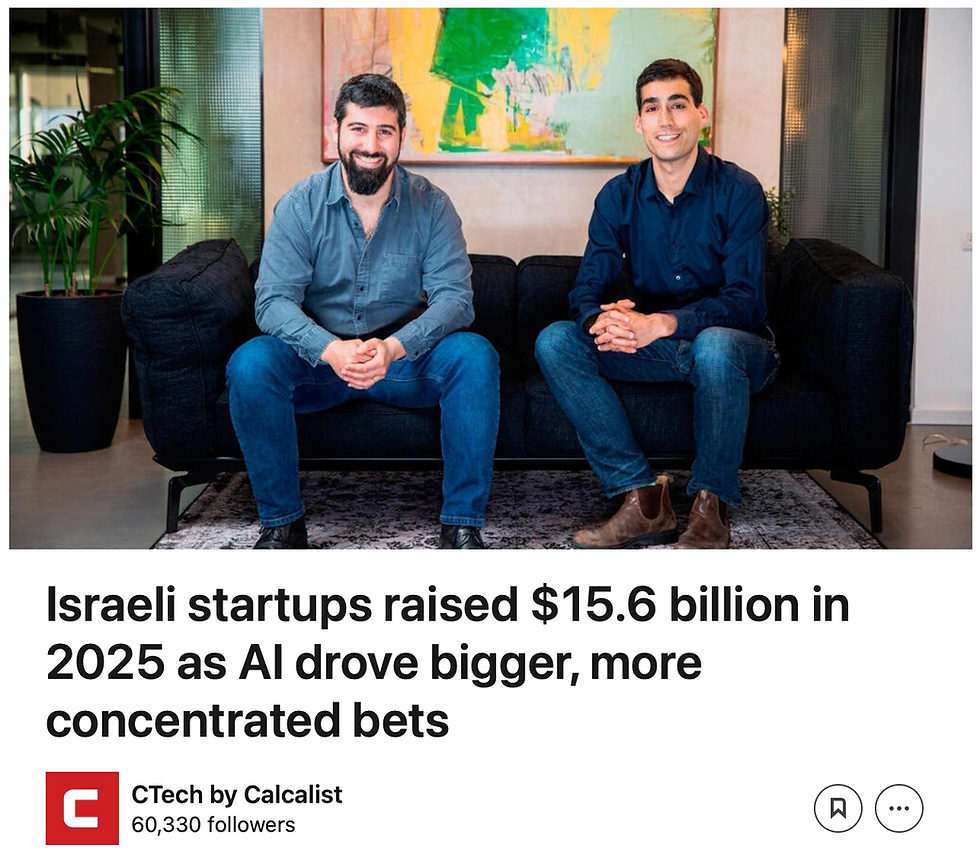
These global dynamics are clearly visible in Israel. According to a report by Start-Up Nation Central, an Israeli think tank, Israeli technology companies raised approximately $15.6 billion in 2025, reflecting a selective but resilient investment environment focused on mature, globally relevant companies.
At the same time, M&A activity accelerated sharply. In 2025, Israeli tech surpassed $80 billion in signed and announced M&A transactions, according to the Calcalist business paper, driven largely by strategic acquisitions by global technology leaders. Companies such as Google, Palo Alto Networks, Microsoft, Intel, and Cisco continue to source Israeli innovation as a core component of their global growth strategies.
Despite this strong M&A momentum, IPO activity remained limited, and many of Israel’s leading technology companies continue to scale as private businesses over extended periods. This dynamic is reinforced by long-term strategic commitments to the ecosystem, including NVIDIA’s announced plan to build one of its largest AI and R&D campuses outside the U.S. in Israel, underscoring the country’s central role in global AI and semiconductor development.
Over the past decade, more than $100 billion has been invested in Israeli venture-backed technology companies. As these companies mature and ownership structures grow more complex, the need for interim liquidity solutions has become structural. Industry estimates suggest that 8–12% of venture-backed holdings return to the market through secondary transactions prior to a final exit, reflecting not declining confidence, but the natural evolution of a maturing ecosystem that supports liquidity alongside long-term value creation.
A Human Process, not just a Financial One
Secondary transactions sit at the intersection of financial objectives and human considerations. Founders, employees, funds, and companies must balance liquidity needs with long-term growth and organizational stability. Successful secondary investing therefore requires more than pricing and structure; it requires judgment, alignment, and sensitivity to timing and context.
The conclusion from 2025 is clear. As technology company life cycles lengthen and ownership structures grow more complex, secondary transactions are not a substitute for exit. They are a critical tool for building durable companies, managing risk, and creating thoughtful liquidity along the journey to that destination.
About the Authors
Fiona Darmon and Merav Weinryb are founders and managing partners of Sunvest Capital Partners, a secondary investment firm focused on acquiring stakes in venture capital funds and private technology companies. Founded in 2023 by seasoned venture capitalists to invest in VC secondaries, Sunvest employs an investment approach that combines bottom-up technological analysis with top-down business and market insight. The firm specializes in acquiring existing stakes from founders, employees, funds, and investors, with a deep understanding of seller needs, structural flexibility, and long-term value creation. Sunvest is among the few women-owned secondary funds globally.
Parts of this article were originally published in Hebrew in TheMarker
Footnote: Women in Venture Capital
According to PitchBook, women now hold approximately 20% of senior investment roles in venture capital and growth equity funds worldwide, nearly double the share from a decade ago. In Israel, a similar shift is clearly visible. More women are stepping into leadership positions as partners at venture and growth funds, serving on boards, and holding senior executive roles at technology companies. The trend points to a more mature, diverse, and balanced ecosystem, one that benefits from a broader range of experience and perspectives in both investing and company-building.
Disclaimer: The views expressed in this article are the authors’ own and do not constitute investment advice. This article is provided for informational purposes only.


Comments